
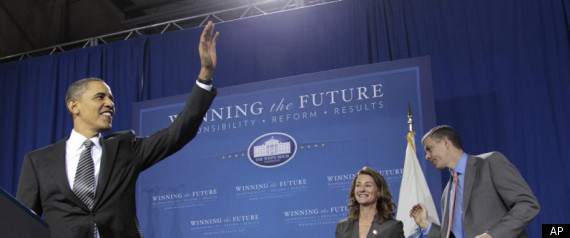
While Democrats and Republicans mostly agree that a sweeping federal law governing education desperately needs to be overhauled, they are divided on how to do it. As a result, Congress may not finish its education homework by the president's deadline.
Barack Obama called for No Child Left Behind, the 2001 law that set the standards and goals for public education, to be revamped by August. According to a report by the Associated Press, an on-time fix is highly unlikely.
Rep. John Kline (R-Minn.), who chairs the House Education and Workforce Committee, said it would be impossible to agree on changes by the deadline. "I've been very, persistently clear that we cannot get this done by summer," he told the AP. "It's just not going to happen."
George W. Bush introduced the law in 2001, pushing it through congress with bipartisan support. But the sailing isn’t as smooth this time around, the AP notes, because of intra-party splits: The wave of Tea Party congressmen voted into office in November 2010 largely oppose sweeping federal laws, which makes it more difficult for Republicans to unite around a course of action. Democrats, on the other hand, remain divided on issues of teacher accountability, such as tenure, merit pay and linking evaluations with test scores.
The widespread criticism the law has faced over the past nine years exacerbates the issue, because few can agree -- regardless of party orientation -- which of its policies should exist in the first place.
As the clock ticks, though, more and more schools are being labeled as failing under the law. NCLB sets grades and standards, giving the federal government power to intervene in schools that rank poorly. The law originally set 2014 as a deadline for 100% proficiency in math and reading.
Educators and policymakers criticize NCLB for circumscribing curricula by encouraging the practice of teaching to the test.
"NCLB needs to be completely revamped in terms of the provisions with respect to the accountability," Pedro Noguera, an education professor at New York University told The Huffington Post. "They have become so punitive."
U.S. Secretary of Education Arne Duncan said in March that 82% of schools were on track to fail, according to the law's standards, by next year. “This law is fundamentally broken, and we need to fix it this year,” he told the House education committee at the time. (A report by the Center on Education Policy calculated the number at a much lower 38%).
"We have been overemphasizing assessment," Noguera said. "Assessment only works as a tool, a tool for providing teachers and schools with information on what students need more of. What we haven’t nearly focused as much time on is quality instruction."
The law has been so cumbersome that Duncan has had to grant more waivers than his predecessor to school districts that have had trouble satisfying some of NCLB's provisions.
The two chambers of Congress are attempting to overhaul the law in entirely different ways. The House began introducing a series of bills that target specific components of NCLB, starting with last week's proposal from Rep. Duncan Hunter (R-Calif.) that would scrap 43 NCLB-funded programs.
The Senate, meanwhile, hopes to introduce a more holistic fix. A comprehensive bill could incorporate the House's individual proposals, but it may be hobbled by House Republicans skeptical of any comprehensive education legislation.
"I think it makes it easier for everybody to understand," Hunter told the AP about the House's approach. "I think people have an aversion to them [comprehensive bills] now."
Kline told the AP that his next targeted bills would include one giving school districts more leeway in budgeting federal money. A subsequent bill would address school accountability and standards.
nini/huffingtonpost
Pages
No Child Left Behind Revamp Stalls As Obama's Deadline Looms
Saturday, May 21, 2011
Posted by
tibi nini
Princeton Charter School Co-Founder Has His Say
Posted by
tibi nini
Parker Block: Suburban schools should innovate and push ahead, not just 'hum along.'
Editor's note—Patch has published several articles recently examining the role of charter schools in well-performing suburban school districts. Acting Education Commissioner Christopher Cerf acknowledged a few days ago that what he called “boutique” charter schools might not be needed in suburban districts that are “humming along.” Parker Block, a co-founder of the Princeton International Academy Charter School (www.piacs.org), sent us the following response:
As the current debate about charter schools in urban and suburban districts unfolds, it is important to recognize that charter schools are intended to be laboratories of innovation that provide, according to the Charter School Program Act, “a mechanism for the implementation of a variety of educational approaches which may not be available in the traditional public school classroom.”
It is common and understandable for school districts to find innovation too difficult to implement in the face of institutional inertia and entrenched parochial interests. In so-called “top performing” suburban school districts, the bureaucratic instinct to defend the status quo is buttressed by data which seemingly justifies intransigence.
Compared to state averages, suburban schools are not under-performing;
they are “humming along.” As long as the “local achievement gap” exists, suburban school districts are under no pressure to innovate and improve.
Despite the fact that the most tragic situations in public education capture media attention, business leaders, policy makers, progressive educators and parents are increasingly aware that in the 21st Century, our students are not going to be judged in comparison to local standards, but by international benchmarks.
To that end, New Jersey became one of the lead states in the Partnership for 21st Century Skills (www.p21.org), an organization working to infuse 21st Century skills into public K-12. The Partnership was a key resource in the development of New Jersey’s revised Core Curriculum Standards in 2009.
One of the reasons for the increased focus on 21st Century skills, according to the Partnership, is the fact that “for the past decade, the United States has focused nationally on closing achievement gaps between the lowest- and highest-performing students—a legitimate and useful agenda—but one that skirts the competitive demand for advanced skills. Equally important is the global achievement gap between U.S. students—even our top-performing students—and their international peers in competitor nations.”
The comparison to local standards may serve suburban school administrators well, but not suburban students. Nonetheless, those who propose innovative, ambitious programs are often summarily dismissed by local school officials with phrases like “nice to have, but not necessary” or “wait until the economy improves.”
President Obama consistently reminds us, however, that continuous innovation, even in times of budget constraints, is necessary if we are to remain economically competitive. Yet, even in Princeton, the president of the school board equates programs that will increase proficiency in math with learning to play bagpipes, and says that fluency in a strategic world language like Mandarin is like learning Gaelic. This exemplifies the complacency, arrogance and protect-the-status quo mentality which has plagued public education for decades and gave rise to the need for charter schools in the first place.
Critics deride schools such as those offering dual-language immersion programs as “themed, boutique schools,” implying that the scope of the education is somehow limited. The intent of a charter school is, according to the law, to offer programs which are differentiated from the program already available in the traditional public schools. If these points of differentiation are considered “themes,” then there is no such thing as a “non-themed” charter school.
Some believe that charter schools only serve a small number of private school families who simply want to have their tuition paid by tax dollars. First, in the case of the charter school of which I am a co-founder, three out of four applicants are already attending a public school within the respective school districts. These are public school parents who simply want forward-thinking programs that better prepare their children to compete in the 21st Century.
Second, if the school is successful on a smaller scale, these innovative programs can and should be replicated in traditional schools for the benefit of the larger community. In her endorsement of high quality charter schools, New Jersey Education Association President Barbara Keshishian states that “it is critical that successful schools of all types share their successes so that other students can benefit from the best practices in all of New Jersey's public schools.”
Innovative programs always require first-adopters before the larger populace is ready to endorse them. Yet public school officials are reluctant to acknowledge charter school successes out of fear of a domino effect;: if one succeeds, there will be others. This Cold War-era paranoia greatly underestimates the difficulty of getting a charter school authorized and established. If parents in the community don’t believe in the school, it won’t survive.
In smaller municipalities like Princeton, the school districts are the most powerful political force in the community, controlling huge budgets, payrolls, and a bully-pulpit from which the politics of fear can be employed to get initiatives passed or killed. This is why the charter school law established “a new form of accountability for schools” by providing parents and educators the opportunity to apply directly to the state Department of Education for the authorization to open a charter school. The same body, which is ultimately responsible for the curriculum standards and public education throughout state, oversees the evaluation and authorization of innovative, high-quality charter schools and holds them accountable to agreed upon targets.
Students in New Jersey who happen to be on the right side of the “local achievement gap” will find themselves on the wrong side of the “global achievement gap” unless the innovation provided by high-quality charters is available throughout the state. President Obama chastises the complacent official who puts parochial interests ahead of progress: “China is not waiting. Germany is not waiting. India is not waiting. These nations—they're not standing still. These nations aren't playing for second place.” The competition our children will face is not just “humming along.” They are pushing ahead. So should we.
Nini/montclair
As the current debate about charter schools in urban and suburban districts unfolds, it is important to recognize that charter schools are intended to be laboratories of innovation that provide, according to the Charter School Program Act, “a mechanism for the implementation of a variety of educational approaches which may not be available in the traditional public school classroom.”
It is common and understandable for school districts to find innovation too difficult to implement in the face of institutional inertia and entrenched parochial interests. In so-called “top performing” suburban school districts, the bureaucratic instinct to defend the status quo is buttressed by data which seemingly justifies intransigence.
Compared to state averages, suburban schools are not under-performing;
they are “humming along.” As long as the “local achievement gap” exists, suburban school districts are under no pressure to innovate and improve.
Despite the fact that the most tragic situations in public education capture media attention, business leaders, policy makers, progressive educators and parents are increasingly aware that in the 21st Century, our students are not going to be judged in comparison to local standards, but by international benchmarks.
To that end, New Jersey became one of the lead states in the Partnership for 21st Century Skills (www.p21.org), an organization working to infuse 21st Century skills into public K-12. The Partnership was a key resource in the development of New Jersey’s revised Core Curriculum Standards in 2009.
One of the reasons for the increased focus on 21st Century skills, according to the Partnership, is the fact that “for the past decade, the United States has focused nationally on closing achievement gaps between the lowest- and highest-performing students—a legitimate and useful agenda—but one that skirts the competitive demand for advanced skills. Equally important is the global achievement gap between U.S. students—even our top-performing students—and their international peers in competitor nations.”
The comparison to local standards may serve suburban school administrators well, but not suburban students. Nonetheless, those who propose innovative, ambitious programs are often summarily dismissed by local school officials with phrases like “nice to have, but not necessary” or “wait until the economy improves.”
President Obama consistently reminds us, however, that continuous innovation, even in times of budget constraints, is necessary if we are to remain economically competitive. Yet, even in Princeton, the president of the school board equates programs that will increase proficiency in math with learning to play bagpipes, and says that fluency in a strategic world language like Mandarin is like learning Gaelic. This exemplifies the complacency, arrogance and protect-the-status quo mentality which has plagued public education for decades and gave rise to the need for charter schools in the first place.
Critics deride schools such as those offering dual-language immersion programs as “themed, boutique schools,” implying that the scope of the education is somehow limited. The intent of a charter school is, according to the law, to offer programs which are differentiated from the program already available in the traditional public schools. If these points of differentiation are considered “themes,” then there is no such thing as a “non-themed” charter school.
Some believe that charter schools only serve a small number of private school families who simply want to have their tuition paid by tax dollars. First, in the case of the charter school of which I am a co-founder, three out of four applicants are already attending a public school within the respective school districts. These are public school parents who simply want forward-thinking programs that better prepare their children to compete in the 21st Century.
Second, if the school is successful on a smaller scale, these innovative programs can and should be replicated in traditional schools for the benefit of the larger community. In her endorsement of high quality charter schools, New Jersey Education Association President Barbara Keshishian states that “it is critical that successful schools of all types share their successes so that other students can benefit from the best practices in all of New Jersey's public schools.”
Innovative programs always require first-adopters before the larger populace is ready to endorse them. Yet public school officials are reluctant to acknowledge charter school successes out of fear of a domino effect;: if one succeeds, there will be others. This Cold War-era paranoia greatly underestimates the difficulty of getting a charter school authorized and established. If parents in the community don’t believe in the school, it won’t survive.
In smaller municipalities like Princeton, the school districts are the most powerful political force in the community, controlling huge budgets, payrolls, and a bully-pulpit from which the politics of fear can be employed to get initiatives passed or killed. This is why the charter school law established “a new form of accountability for schools” by providing parents and educators the opportunity to apply directly to the state Department of Education for the authorization to open a charter school. The same body, which is ultimately responsible for the curriculum standards and public education throughout state, oversees the evaluation and authorization of innovative, high-quality charter schools and holds them accountable to agreed upon targets.
Students in New Jersey who happen to be on the right side of the “local achievement gap” will find themselves on the wrong side of the “global achievement gap” unless the innovation provided by high-quality charters is available throughout the state. President Obama chastises the complacent official who puts parochial interests ahead of progress: “China is not waiting. Germany is not waiting. India is not waiting. These nations—they're not standing still. These nations aren't playing for second place.” The competition our children will face is not just “humming along.” They are pushing ahead. So should we.
Nini/montclair
Education for all: A global imperative
Posted by
tibi nini
This week we saw the gulf that lies between the values of the Left and Right get even wider. Through a leaked letter, the public was made aware that Tory frontbencher Liam Fox is angry about so much of the British taxpayers money going to help those in the world’s poorest and most vulnerable nations.
Gordon Brown, on the other hand, has been spending his time in Africa where today, he launches a report (pdf) highlighting why development aid is so important and how meeting a millennium goal target on education can actually help stimulate economic growth all over the world.
By meeting our commitment to ensure that the planet enjoys universal primary school education, the report states that we can increase economic growth in the worlds poorest countries by 2% per capita.
Furthermore, it could help lift 104 million people out of poverty and save the lives of almost two million children in Africa.
The report (pdf) is packed with quality data and first-class analysis highlighting the important role that education plays in propelling development and the improvement in the welfare of the world’s poorest.
One of the key arguments of the report is the value for money represented by investing in education.
For every $1 spent on education, a further $15 is likely to be generated as a result of laying the foundations for today’s children to become tomorrow’s wealth creators, opening up countless new investment opportunities; furthermore, if action is taken within the next five years, aid dependency would be vastly reduced and even pay for itself after 22 years.
The tireless work of both Gordon and Sarah Brown in promoting such a worthy and important campaign to reduce poverty and create prosperity for the world’s poorest serves as an inspiration for all those working for a better future world.
The incredible tasks of eradicating poverty all over the world and meeting environmental challenges never faced before, call for bold leadership and strong vision. The kind of work represented in today’s report provide just the sort of vision necessary.
Surely even Dr Fox and his friends in the cabinet couldn’t disagree?
NIni/leftfootforward
Gordon Brown, on the other hand, has been spending his time in Africa where today, he launches a report (pdf) highlighting why development aid is so important and how meeting a millennium goal target on education can actually help stimulate economic growth all over the world.By meeting our commitment to ensure that the planet enjoys universal primary school education, the report states that we can increase economic growth in the worlds poorest countries by 2% per capita.
Furthermore, it could help lift 104 million people out of poverty and save the lives of almost two million children in Africa.
The report (pdf) is packed with quality data and first-class analysis highlighting the important role that education plays in propelling development and the improvement in the welfare of the world’s poorest.
One of the key arguments of the report is the value for money represented by investing in education.
For every $1 spent on education, a further $15 is likely to be generated as a result of laying the foundations for today’s children to become tomorrow’s wealth creators, opening up countless new investment opportunities; furthermore, if action is taken within the next five years, aid dependency would be vastly reduced and even pay for itself after 22 years.
The tireless work of both Gordon and Sarah Brown in promoting such a worthy and important campaign to reduce poverty and create prosperity for the world’s poorest serves as an inspiration for all those working for a better future world.
The incredible tasks of eradicating poverty all over the world and meeting environmental challenges never faced before, call for bold leadership and strong vision. The kind of work represented in today’s report provide just the sort of vision necessary.
Surely even Dr Fox and his friends in the cabinet couldn’t disagree?
NIni/leftfootforward
Subscribe to:
Posts (Atom)
Popular Posts
-
Strongly objecting to the use of lethal force against peaceful demonstrators, the United States said that it is considering all appropriat...
-
ROME -- AS Roma has accepted coach Claudio Ranieri's resignation and replaced him with former forward Vincenzo Montella. Ranieri of...
-
Protesters carrying food and tents poured into Manama’s Pearl Square on Monday, intensifying their calls for an end to the Sunni Al-Khalifa...
Search This Blog
Labels
- education (9)
- Entertainment (7)
- food (5)
- Indonesia (17)
- International (59)
- Music (10)
- news (246)
- religion (13)
- sport (176)
- Video (11)


