Michael Gove loses High Court case over scrapping school building projects

Saturday, February 12, 2011


Michael Gove, the Education Secretary, lost a High Court battle to cancel school building projects yesterday in a landmark case which threatens to slow the Government’s spending cuts.


A judge told Mr Gove he was wrong to scrap the £55 billion Building Schools for the Future scheme last July because it violated equality legislation.
Mr Justice Holman said Mr Gove failed to properly consult six local authorities before imposing the cuts, and in five of the cases his decision amounted “to an abuse of power”.
The ruling means that other groups affected by central or local government cuts could apply for a judicial review if they believe they have not been adequately consulted.
More than 700 building projects across England were cancelled as a result of Mr Gove’s decision, provoking anger from councils and leaving school repairs and rebuilds unfinished. Nottingham City Council, Kent County Council, Luton Borough Council, Sandwell Council in the West Midlands and Waltham Forest and Newham councils in London, were the authorities to challenge the Government’s decision.
Chris Robbins, the leader of Waltham Forest Council, called the decision “a victory for common sense and fair play”. David Mellen, Nottingham council’s portfolio holder for children’s services, said: “This is a powerful judgment and a vindication of all the determination and hard work that has brought us to this point.”
The judge said Mr Gove’s decision-making process was unlawful “because of his failure to discharge relevant statutory equality duties under the Sex Discrimination Act, Race Relations Act and Disability Discrimination Act”.
The Equality Act, championed by Harriet Harman, the deputy Labour leader, was introduced last year to bring the various areas of equality law under one piece of legislation.
Lawyers said its impact would grow as council budgets came under pressure. Stephen Hocking, a partner at Beachcroft LLP, a commercial law firm, said: “The Equality Act has profound implications for local authority decisions in relation to the delivery of public services — and the impact of the Act will only be increased by the cuts in local authority budgets over the next few years.
“The Act is making it much harder for government and local authorities to make any cuts to services and this is an increasingly precarious area for them.”
The judge said local authorities would be allowed to make representations to Mr Gove and he would have to reconsider his decision, but that he would still have the final say in the matter. He will not appeal against the ruling
Lawyers for Mr Gove said his decisions were not made lightly and should not be open to legal challenge. They said the Coalition had inherited “the largest budget deficit in peacetime history”, and that spending cuts had to be made “quickly and significantly”.

An American in Pakistani custody

Who exactly is Raymond Davis, the main at the centre of a flaming row between the United States and Pakistan that threatens to derail ties altogether ? It’s an obvious question to ask given the lengths the Obama administration has gone to secure the release of Davis held in Pakistan for shooting and killing two men who he said were trying to rob him. As Reuters reported this week, Washington had put on hold some bilateral engagements, and even hinted that a $7.5  billion civillian aid package could be jeopardised if Islamabad continued to hold Davis disregarding his diplomatic immunity. The New York Times and the Washington Post said a much-sought after state visit by President Asif Ali Zardari planned for the end of March was on the line now. U.S. Secretary of State Hillary Clinton cancelled a meeting with Pakistan Foreign Minister Shah Mehmood Qureshi at an international security conference in Munich late last month, the Post said.
The Americans are saying Davis is a diplomat and hence arresting him is a violation of international norms and the Vienna Conventions.  The U.S. embassy had initially identified him as a staff member of the U.S. consulate in the eastern city of Lahore where the incident occured.
Pakistanis on the other hand are outraged by the incident, seeing it as another case where the Americans are acting with impunity in their country. Not only are they conducting air strikes in an ever widening arc in the troubled northeast corner of the country, but they also operating in the streets of  the largest cities unchallenged, they feel.  Religious parties which have long condemned U.S. involvement in the country have hit the streets demanding that the government  stand firm against U.S. calls to release the man.
 A Lahore court has barred the government from handing over Davis to U.S. custody.  It says it will decide whether he had diplomatic immunity or not. On Friday the court extended his remand by another 14 days, infuriating the Americans further.
The facts of the case are so heavily disputed that its hard to say anything with finality The question is not only who Davis is but  there are also questions about the identity of the two men he killed. Katharine Tiedemann  of Foreign Policy’s AFPAK channel  recounts  the things that the United States and Pakistan disagree  over in this pareticular case. What does he do ? Who did he shoot ?. How did he shoot them ? Does he or does not have diplomatic status ?
And then why did he shoot them even if it was robbery ? And then of course as the Pakistanis are asking, how dare he shoot them ?
Given the explosive mood in the street where anti-U.S. sentiment is  already so strong, the bigger question is why is America ready to go against the tide of public opinion in Pakistan ?    Especially why so openly ? At a time when it is struggling with the uprising in Egypt, another ally, the last thing it would want is a similar crisis in Pakistan, another country where it is shoring up an unpopular government,  Selig Harrison says the United States must accept Pakistan’s handling of  the case for now, in order to defuse public opinion.  America must continue its covert war against al Qaeda and the Taliban inside Pakistan , but without lighting the fuse of public fury against it.
Or has Washington reached a point where it has had enough of forging a cooperative relationship with its conflicted ally ?  As we wrote this week, the standoff over the U.S. shooter is only one of a series of issues that has opened a deep divide between the two countries. Despite U.S. calls, Pakistan hasn’t gone after the Afghan Taliban sheltered on its soil whether it is the Quetta shura in Baluchistan or the Haqqani network in North Waziristan.  Far from reining in its nuclear ambitions in a dangerous regional environment, Pakistan has by all accounts actually increased the size of its nuclear arsenal to the point that it may soon overtake Britain as the world’s fifth largest nuclear power.  That makes a mockery of Western fears of the risk of  militant groups sneaking material away from its nuclear facilities.
And despite billions of dollars of aid and an IMF loan programme to keep its economy afloat, Pakistan has failed to implement the reforms that are necessary to put its books in order over the longer term. So why should Washington indulge  a country that looks less an ally and more an obstacle in its fight against militant groups.
And from Pakistan, America must look, by now, a bigger problem than even the traditional enemy India. It has lost more men in the fight against militants than the number of troops the United States has lost in the 10-year war in Afghanistan, and yet its commitment to the fight has been repeatedly questioned.  It has allowed the United States to run what must be the world’d’s largest covert air campaign agsinst al Qaeda and the Taliban in the northwest region, and yet America is not satisfied. From time to time American commanders speak of taking the fight deeper into Pakistan including attacking the Quetta shura.
Even more galling must be Washington’s efforts to forge a strategic relationship with arch rival India and turn it into a global power, while making demands on Pakistan that often ran counter to its interest. Thus while it ended India’s nuclear isolation by signing  a  nuclear cooperation agreement despite New Delhi’s weapons programme, it refused Pakistan a similar deal.  Worse, many in Pakistan believe that a key part of the U.S. agenda is to defang its nuclear prowess. That, to most Pakistanis, is not the sign of friendship.

US asks Pakistan to free detained official

LAHORE, Pakistan — The United States on Friday renewed demands for Pakistan to immediately release a detained American official who Washington says acted in self defence when he shot dead two men.
The latest US call came hours after Pakistani police rejected the self-defence claim of Raymond Davis, who shot dead two men in broad daylight, and accused him of cold-blooded murder as a court extended his remand.
"As a member of the administrative and technical staff at the US embassy in Islamabad, Raymond Davis is entitled to full immunity from criminal prosecution by Pakistan under the Vienna convention," US Consul General Carmela Conroy said.
Reading out a written statement to media in Lahore, Conroy, who met Davis in jail, said that under the convention,"he should be freed immediately".
"We need to resolve this case immediately and continue our work, including cooperation in education and health, our common fight against extremist violence, and building bridges between the people of Pakistan and America."
"We regret that authorities did not consider... eyewitness accounts and physical evidence when they stated that this was not a case of self-defence," she added.
Lahore's police chief Aslam Tareen had told a press conference Friday morning that "It was cold-blooded murder".
On January 28, the US embassy identified him as a "staff member of the US consulate general in Lahore", the next day as a "diplomat assigned to the US embassy in Islamabad".
Under international laws, embassy diplomats have full diplomatic immunity whereas consular officials are liable for detention in case of grave crimes.
"This incident was a tragedy, and we feel tremendous sorrow over the loss of life. We extend our deep sympathy to all family members who have been affected," Conroy said, but refused to take any questions.

Chapel Club interview Lewis Bowman, Michael Hibbert

There can only be those living a hermit-like existence in some deep forest enclave who have not happened upon the name of Chapel Club sometime over the last year- more often that not accompanied by the terms ‘dark’, ‘intense’, brooding’ to describe their musical and lyrical output that seems to capture the attention of all who fall under its spell.

The Chapel Club inception took place in late 2007 when guitarist Michael Hibbert (formerly with indie rock outfit Hope of the States) met the then 17 year old Liam Arklie (bassist), later to be joined by Alex Parry (guitar), drummer Rich Mitchell (who has also played with Florence and the Machine and Paul Weller), and Lewis Bowman (vocals). With the line-up complete, the band began to rehearse and play a few shows local to their east London base under the names of Palace and Golden Age. By the autumn of 2009 they had embarked on hosting their own residency at the Shacklewell Arms in London’s Dalston and adopted their third, and final name: Chapel Club.

Throughout the course of 2009/10, Chapel Club although receiving radio airplay with their first ‘intended’ single ‘Surfacing’ (aborted before actual release due to copyright issues over the Dream A Little Dream Of Me sequence and finally released last month) and follow-ups ‘O Maybe I’, ‘All The Eastern Girls’ and ‘Five Trees’, playing a host of festivals across the country (including Glastonbury and Reading/Leeds), they have remained firmly on the ‘ones to watch’ lists, without kicking into touch. Now, with the long-awaited debut album revealed and received to overall approving commendation (charting in its first week at #31), Chapel Club are one of the most talked about - and must-be-seen - bands currently in the UK. On their first headlining tour, Music News catches up with the fast-rising Lewis Bowman and Michael Hibbert.

Music News: So, the album is finally out and you are about to start your first headlining tour – how are you feeling?

Michael Hibbert: I’m feeling good. Quite relieved that the album is actually out. It was recorded over six months ago, so I think for any band to sit on something for so long, it is very frustrating – especially as we write quite quickly and have been pretty prolific of late. So, yeah, it’s a relief to have it out! And we’ve got the tour too. In fact, we’re pretty much on tour until the end of the year now. I’m very excited.

MN: Is the final Palace product what you envisaged at the start?

MH: Yeah, I think we probably exercised a little restraint when we were starting out, but yeah, pretty much how I’d imagined it. Blind is one of my favourite tracks, and I think that will be the next single. It appears to be a bit of a stand-out on the album from what I can gather reading the reviews. We haven’t played it very much live either as it is quite a hard track to recreate live. I think that’s why it still sounds fresh to us, compared to some of the other songs.

Lewis Bowman: I think Palace is a very honest depiction of where we were at, at that time. The songs all came from the earliest period of our being a band. The songs have really strong lyrics, and I’m pretty proud of it all, and that people seem to have got into it and are really feeling it. The tour is going well, I think. The first show in Bristol sold out on the night, which was a good start. Some people were telling us afterwards that the set was too short. We tend to kind of underestimate, I think, how much people actually want to watch us (laughs), so we have been extending the set.

MN: Have you noticed any change in audience reaction this time round, now that people have had a chance to hear the album?

LB: There’s definitely a more varied audience from the last UK stint we did. A lot more younger people than in the past. And, yeah, a lot of singing along on The Shore and All The Eastern Girls.

MN: You have tasted a little of what success is like with Hope of the States [formed in 2000 and split days after playing Reading festival in 2006, their album, The Lost Shots, making the UK Top 40] so are you able to take a more laid-back approach to all that is happening now for Chapel Club?

MH: My role in the States was quite minimal really. I didn’t have much say in the band. I basically did my part, did my thing and played guitar and left it at that really. This time round with Chapel Club I made sure I am far more involved.

LB: We are very democratic. We have to be like that because everyone wants to contribute. We’re not like a band where just one person seems to have a singular vision for the band says this is the way it’s going to be and come out with an album that is entirely the product of that one person’s focus and vision.

MN: How did you all come together?

MH: After States split, I spent a year doing nothing really. I needed a little time to think about what I was going to do. Then I met Liam and we discussed the idea of possibly writing some music together. We just wanted to have a little bit of fun. And it all progressed from there. I met Alex, Lewis was a friend of a friend, Rich got involved and it all snowballed…a very, very slow snowball! (laughs). I was in no rush to go out and tour or whatever I wasn’t happy with, or be on the road with people I didn’t like. I’d done all that before and it was quite exhausting.

MN: You obviously felt you could work with these other four?

MH: Yeah. We’re all very close. It makes life a hell of a lot easier. We enjoy each other’s company, and when it comes to writing and touring, it makes that a pleasure.

MN: You elected on the title ‘Palace’ for the album. Given that was the name of the early Chapel Club incarnation, wasn’t it a step back?

MH: No, it’s relevant for a number of reasons. It fits with the whole thing of the last two years. A lot of the songs were written around that time when we were toying with the idea of calling ourselves Palace, and it’s a rich, grand-sounding record, so the title fits perfectly, I think!

MN: Lewis, you have called The Shore ‘the heartbeat of the whole album’. This is one of Chapel Club’s first penned numbers, isn’t it?

Lewis Bowman: Yeah, The Shore was one of the songs we did in the first sessions with Paul [Epworth, producer of Palace] when we were still trying to decide on a producer; it was one of the songs we did then. It has literally got this pulsing, wave-like kind of undertow to it, so that is the ‘heartbeat’ part. When we did it, I think it was Paul who said that he thought this song could be the way for how we approached the album. It was the first song that we thought this works so well with this kind of production. It acted as a reference point for the songs we recorded afterwards. It’s my favourite song on the album, actually, by quite a stretch. I’m pretty happy with that one.

MH: It made it easier, I think, working with someone like Paul whom I already knew. I bumped into him in Denmark Street one day and we discussed the idea very briefly over lunch. By the end of the lunch, we’d pretty much decided we should work together. We went into the studio and did All The Eastern Girls in two or three days. The results were very much how we’d imagined, so it was all quite quick and stress-free!

MN: When you have come up with a lyric and take it to the others, do you ever get that ‘what the hell is this one all about?’ reaction?

LB: They’re musicians (laughs), but I’m not saying it’s not possible! Every now and then, yeah, they will say ‘What is that about?’ Sometimes they’re impressed, sometimes they’re bemused and bewildered by the answer they’re given. But generally they have faith in me.

MN: Lewis, you made reference once to our being ‘all God’s widows in a way’. I wondered whether that has any relevance to the lyric of Widows [from the Wintering EP] itself?

LB: Erm, no…I think I was probably talking about The Shore or something – maybe in a very light and frothy way, about the issues encountered to do with faith and stuff. Widows as a song is pretty simple really. It’s about a relationship – as so many of the songs are - about a girl…

MN: It’s one hell of a song.

LB: I think it’s definitely the best thing we have done so far.

MN: Will you be including Widows on this tour, or In My Moments [B-side to Surfacing single]?

MH: Widows we will be doing, certainly in London and possibly at some of the other shows [it made its live debut, as it later transpired, at the Sheffield Leadmill on the third night], but it’s like, eight minutes long! (laughs) In My Moments we haven’t rehearsed or played in a long time. It may make an entry at some point, but not on this tour. There’s a couple of songs on the album we won’t play – and probably won’t ever – but In My Moments...yeah, I’d forgotten about that one, actually. Alex is quite keen to do it at some point, and we’ve got a lot of gigs this year, so I’m sure we’ll be mixing the set up.

MN: The later Wintering material is very different to Palace. Will this sparser sound be the way forward for Chapel Club?

MH: I would say the EP is definitely more an indication of where we’re going. It’s a massively different sound.

LB: Basically, we recorded Wintering a good six months after the last Palace song - which was Fine Light - was written. I think that stylistically we are all pretty open and will do whatever we want. We don’t want to be hemmed in or pigeonholed, or feel like we have to do something in a certain Chapel Club way. We don’t want to be anything other than ourselves and see where that takes us because that will be more interesting.

MH: I don’t know of many other bands who are doing something like that right now, which is why I want to get the second album done quickly because I know it’s going to have a lot of elements like that on it. I want to do it before someone else steals it! (laughs). It’s a bold move, even though I say it myself.

MN: Do you have an idea as yet when the second album might be forthcoming?

MH: We’ve already demo’d four songs, and have got a couple more on the back-burner. We’d like the next one out by the start of next year, but whether that will happen or not is another matter.

MN: Do you prefer the writing and recording side to touring?

LB: I definitely prefer it. I can cope with the touring because I get on with the guys well and it’s a privilege to be able to do it rather than having to go into an office, 9-5. But I’d be lying if I said I enjoyed the kind of lifestyle it demands. I’ve got a fiancĂ©e and a life at home. I know I sound ungrateful and the other guys are always telling me, oh how can you be like this; this is the most fun you can have in life! But I just…I’m pretty attached to the quiet, the calm. And I find singing live, being that emotional on stage every night, quite exhausting.

MH: I enjoy the touring. I feel very, very comfortable on stage. Every album we tour, I want the tour to be a very different experience, so rather than watching a band play all their hits or whatever, it feels like a show tailor made to that venue and that night. That’s ultimately the goal.

MN: Are there some songs more difficult to others to translate from record to live performance?

MH: We don’t try to recreate every track. I think for a guitar band it is quite important to actually make some of the stuff sound slightly different live. And certainly that’s the case with this particular album. I don’t know if we will always do it that way, but for now we work on each track as it feels. The track leads its own way really and you know pretty quickly if it is working or not. It’s not something we put a huge amount of thought into: what works, works. There are no hard and fast rules, like we will never use a backing track or whatever. I like the idea of boundaries, but I don’t like the idea of rules. I think it restricts you as a band.

MN: You’re going to be quite busy over the next months: UK tour, then touring the US and Europe. Will Palace be released in the States?

LB: It will be, yeah. I can’t remember when they were saying it was going to be out? I think it might be around May, not in time for the tour, unfortunately.

MH: It’s out biggest headline of Europe. I think we’re away for about 3 weeks or something. It’s going to be quite a slog – for us, anyway. I’m really excited about going over to the US. We’ll be going to San Antonio – somewhere I never thought I’d go in my life – driving through Nevada, Arizona, Texas, playing SXSW festival, Minneapolis, Chicago. We’re not doing that many shows, but we get to drive right through the country.

LB: There’s a lot being discussed. It’s all to do with how much we can afford to do, because it’s hard making money touring, especially in the US, when you’re a band of our size and pretty new. Well, we don’t make money yet, but it’s hard to make ends meet. But it's going to be a good experience.

Tibi/music-news

asia markets mixed as shanghai recovers

Asian stock markets were mixed on Thursday as Shanghai revived after China's rate hike put the region on edge, while oil prices again rose due to worries about Egypt.


The Shanghai Composite Index ended the session up 1.59 per cent, or 455.41 points, at 2,818.16, led by a surge among car makers after they reported strong January sales.
Hong Kong's Hang Seng fell 1.97 per cent, or 455.41 points, at 22,708.62. The index has lost five per cent this week.
Tokyo's Nikkei closed 0.11 per cent, or 12.18 points, lower at 10,605.65 as Japanese traders went into consolidation mode before a public holiday and after a weak lead from Wall Street.

In Tokyo Toyota stood out, with the car giant's shares surging after it revised its full-year earnings outlook upwards, the US government found no fault with electronic systems blamed for acceleration problems, and reports emerged of a planned joint venture in Russia's Far East.
China's latest move to rein in inflation with an interest rate rise on Tuesday continued to worry Hong Kong, as US Federal Reserve chief Ben Bernanke made rare criticism of the Beijing central bank's anti-inflationary strategy.
Steven Leung, sales director at UOB KayHian in Hong Kong, told Dow Jones Newswires that "inflationary pressures in China continue to unnerve investors and we don't expect any rebound in the local bourse to be significant."

Adding to market worries, a newspaper controlled by the Chinese central bank carried a prediction by a government economist that inflation could exceed five per cent for the first two months of the year.
On Wednesday, Bernanke called China's interest rate hike a "surprising" way to tackle inflation, and urged Beijing to instead let its currency rise.
In rare criticism of another central bank's policies, he told a committee in the House of Representatives: "It would be both in our interest and in the Chinese interest for them to raise the value of their currency. And it would help them with their inflation problem."
Oil prices were higher on persistent concerns over the crisis in Egypt, where the embattled government has warned of a military crackdown against protesters.
In other markets, Singapore tumbled 1.50 per cent, with Singapore Telecom falling 1.3 per cent after reporting marginally higher third quarter earnings.
Seoul ended 1.81 per cent lower, Taipei fell 1.89 per cent, Jakarta fell 1.28 per cent, Kuala Lumpur closed down 2.09 per cent, Manila fell 2.73 per cent, and Bangkok fell 2.14 per cent.
Mumbai ended 0.74 per cent lower.
Shares in companies belonging to the Reliance Anil Dhirubhai Ambani Group rebounded after taking a hammering on Wednesday on rumours that India's top accounting body was looking into its financial affairs.
Investors wiped $2.6 billion off the value of shares in the group's six publicly traded companies. Bosses on Thursday described the rumours as "completely false and baseless".

Fears for man who filmed Indonesia mob attack

JAKARTA, INDONESIAN - An Indonesian man who risked his life to film a mob brutally lynching members of his minority Islamic sect is in grave danger and has gone into hiding, rights activists said Friday.
   
The harrowing video of Sunday's attack shocked the mainly Muslim nation and graphically illustrated rising levels of intolerance and violence directed at religious minorities such as the Ahmadiyah sect.
   
It showed police running away as hundreds of Muslim thugs screaming "Allahu akbar" (God is greatest) attacked a house belonging to an Ahmadiyah leader.
Three sect members were stabbed, clubbed and stoned to death.
   
"There was a warning from the national police detective that if the man appears in public, his life could be in danger," National Human Rights Commission deputy chairman Joseph Adi Prasetyo told reporters.
   
"Based on information from the police intelligence unit, the situation was very dangerous and could lead to his death."
   
The commission cancelled a press conference with the man, identified only as a civil servant called Arif, due to the unspecified threats. Arif was seen being led away to secure location wearing dark sunglasses.
   
National police spokesman Boy Rafli Amar confirmed that Arif, a member of the Ahmadiyah community, which numbers in the hundreds of thousands in Indonesia, was under police protection.
   
"Arif is being questioned as a witness related to the Cikeusik incident," he added.
   
The Ahmadiyah differ from orthodox Muslims in that they do not believe Mohammed was the last prophet. Under pressure from hardliners in 2008, the government issued a decree restricting their religious freedoms.
   
Police earlier five people had been arrested over the lynching in Cikeusik village, West Java province, and others seen in the video were being hunted down.
   
More than 1,000 extremist Muslims took part in the assault, armed with machetes, sticks and stones, and wearing blue ribbons to identify themselves from their targets.
   
Arif filmed them entering the front yard and pushing police aside with shouts of "infidel" and "burn the Ahmadiyah".
   
A small group of Ahmadiyah inside responded with rocks and punches but were quickly overwhelmed.
   
Apparently mistaken for a journalist by the mob, Arif kept filming as the attackers began destroying the house and hunting down any defenders who had tried to flee.
   
One half-naked man was filmed being clubbed and stoned to death in the yard, while the bodies of two others were filmed being clubbed, stoned and otherwise defiled as onlookers laughed and took photographs.
   
Police knew of the attack but failed to intervene to protect the Ahmadiyah.
The footage shows police fleeing the initial clash and milling around in the mob passively observing the mayhem.
   
A police spokesman said that provincial police chief Agus Kusnadi, who supervised the area, had been demoted.
   
"The demotion was caused by the interest of the organisation. There was a system that did not run well," police spokesman Anton Bachrul Alam said.
   
Similar attacks in the past have been attributed to Ahmadiyah "provocations", and while some Muslim leaders have tried to blame the victims again this week the film speaks for itself.
   
Two days later another mob of enraged Muslims rampaged through the streets of Temanggung, Central Java, and set fire to churches after a Christian man was jailed for insulting Islam. The crowd wanted him executed.
   
Police said eight people had been arrested over the incident.
   
President Susilo Bambang Yudhoyono has ordered the police to go "all-out" against any extremist groups behind the unrest, although none has claimed responsibility.
   
Human rights activists say the ex-general has repeatedly failed to tackle the sources of intolerance in the country of 240 million people, 80 percent of whom are Muslims.

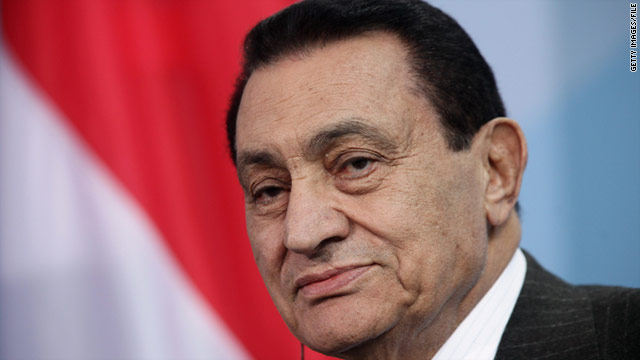
Debate swirls over Mubarak legacy

Cairo, Egypt (CNN) -- For nearly 30 years, one man dominated Egypt.
Hosni Mubarak, 82, survived would-be assassins and ill health, crushed a rising Islamist radical movement, and maintained the peace with neighboring Israel that got his predecessor killed. His government's continued observance of the Camp David accords was the cornerstone of what peace has been achieved in the decades-long Arab-Israeli conflict.
But following the revolt that toppled Tunisia's longtime strongman, demonstrators in the streets of Cairo stood up to riot police, chanting, "Mubarak, Saudi Arabia is waiting for you."
Ultimately, the demonstrations helped bring down the man critics called Egypt's last pharaoh.

Mubarak decided Friday to step down, Vice President Omar Suleiman said on state television.
Now that Mubarak is finally exiting the political stage, the debate over his legacy is growing louder.
Longtime observers of the region say the stability Mubarak purchased for nearly three decades came at the cost of entrenched poverty and repression in the Arab world's most populous nation.
"Egypt is a broken country," Fawaz Gerges, a professor of Middle Eastern relations at the London School of Economics, told CNN. "It used to be the jewel of the Middle East. It's the capital of its cultural production." But now, Gerges said, "Egyptians have no outlets. They don't feel that they have a sense of hope for the future."
Mubarak was a Soviet-trained pilot who was chief of staff of Egypt's air force during the 1973 Mideast war. The early success of Egyptian pilots against Israel made him a national hero, and then-President Anwar Sadat made him vice president in 1975.
Six years later, Sadat died in a hail of gunfire at a military parade, killed by Islamic militants from within the army's own ranks after he took the dramatic step of making peace with Israel. Upon assuming office, one of Mubarak's first acts was to declare a state of emergency that barred unauthorized assembly, restricted freedom of speech and allowed police to jail people indefinitely.
He made extensive use of those powers in the ensuing decades. The Egyptian army put down riots by disgruntled police officers in 1986, and he threw an estimated 30,000 people in jail when jihadists carried out a string of attacks on tourists.
"He pretty much wiped them out," University of Michigan Professor of History Juan Cole said. "It's not an accident that they were in Afghanistan instead of Egypt." The government penetrated opposition movements so thoroughly that "if five people (sat) down to plot something, the fifth person (wrote) a report to Hosni Mubarak about it," he said.
The result was "a regime that has very little legitimacy, but presents itself as something there's no point in trying to change," said Nathan Brown, a professor of Middle Eastern politics at George Washington University in Washington.
But Brown said the January 14 overthrow of Tunisian President Zine El Abidine Ben Ali, who fled to Saudi Arabia after 23 years in power, changed the thinking of many in the region.
"I think what the events in Tunisia did was take that sense that nothing could ever change and lead a few people to question it," he said.
Mubarak headed off a similar movement in 2005, when Egyptians mounted large-scale protests to demand fundamental and widespread reform. He intimidated the leaders of the officially banned but tolerated Muslim Brotherhood, harassed middle-class demonstrators and managed to pick off the leadership of those protests, Brown said.
But the most recent protest movement had "no real leadership, so it (couldn't) be decapitated the same way," Brown noted.
Mubarak won four terms as president in elections that were considered formalities. His fifth, in 2005, was Egypt's first multi-party presidential vote, but it was widely criticized as a "sham," Cole said.
Meanwhile, the country's economy stagnated for the first 20 years of Mubarak's rule. Development picked up in the last decade, fueled by a move away from state control and by billions in tourist dollars, but gains were "very unevenly distributed," Gerges said. About 40% of Egyptians currently live in poverty, he noted.
The aging autocrat escaped at least two assassination attempts, including a close call in 1995 when Islamic militants opened fire on his motorcade at a pan-African conference in Ethiopia. In recent years, Mubarak had several bouts of illness but never picked a vice president. He was widely believed to have anointed his son Gamal as his successor, but later insisted he never intended for his son to take power.
In 2003, Mubarak collapsed while delivering a televised speech to the Egyptian parliament -- returning later to blame his illness on the flu. He had back surgery in Germany in 2004, returning in 2010 to have his gall bladder removed. He largely withdrew from public view in recent years.
His domestic political situation was closely watched overseas, particularly in the United States. In the past decade, Egypt has been a major player in Israeli-Palestinian peace talks, and it contributed troops to the U.S.-led coalition that drove Iraq out of Kuwait in 1991. It receives about $1.3 billion in military aid from Washington every year -- second only to Israel -- and has received nearly $30 billion in economic aid since 1975, according to State Department figures.
But it opposed the U.S. invasion of Iraq in 2003, and while sticking with Camp David, Egypt's ties with Israel amount to a "cold peace," Cole said.
President Barack Obama said recently that Mubarak was "very helpful on a range of tough issues," but prodded the Egyptian leader to take steps toward reform.
"You can see these pent-up frustrations that are being displayed on the streets," Obama said. He urged the Egyptian government to avoid resorting to violence to put down the recent demonstrations, adding, "I think it's very important that people have mechanisms in order to express legitimate grievances."
Gerges said the Middle East has seen "the barrier of fear" removed since the events in Tunisia.
"Arabs really no longer feel terrified of the security apparatus" in Egypt and elsewhere, he said. "We're going to have a new era of politics."