Lapis Singkong

Thursday, March 31, 2011

Material:

1 kg of cassava, peeled, grated

300 ml coconut milk
150 g granulated sugar
Food coloring, to taste
1 packet gelatin powder white

Topping, steamed into one:
100 g coconut peel, grated lengthwise
½ teaspoon salt


Method:


  1. Squeeze cassava, set aside. 
  2. Prepare a 20 cm square baking pan, basting with oil. 
  3. Mix the coconut milk, sugar and gelatin and stir well. 
  4. Enter the grated cassava and stir well. 
  5. For those into 3 parts, give a coloring to taste. 
  6. Pour one part of dough in pan. Steamed in a steam heat until cooked. 
  7. Cover with the second batter. 
  8. Steamed and do the same with the third batter. 
  9. Steamed until fully cooked. 
  10. Remove and let cool. 
  11. Cut into pieces 1.5 cm thick. Sprinkle with grated coconut. 
  12. Serve. 
  For 30 pieces

Peach Bread Pudding

Ingredients:
6 white dinner rolls, cut into 4 parts
3 eggs chicken
75 g sugar
400 ml fresh milk
1 tsp vanilla powder
100 g canned peaches, drained, thinly sliced
Topping:
1 tablespoon granulated sugar
2 tablespoons chopped peanuts

Method:
* Arrange the bread slices in small bowls.
* Beat eggs and sugar until dissolved.
* Add milk and vanilla.
* Pour into a bowl of bread.
* Give Topping ingredients.
* Bake in hot oven 30 C for 30 minutes.
* Remove and serve immediately.
    For 6 units

Salmon Teriyaki

Material:
100 g fillet of Norwegian salmon
10 g zucchini, thinly sliced
10 g carrots, thinly sliced
10 g broccoli
10 g baby green beans

10 g bean sprouts moyashi / big bean sprouts
90 ml teriyaki sauce (see recipe)
75 g lettuce
Teriyaki Sauce:
250 ml of sake
400 ml mirin
Soyu 1.5 Ltr.
125 g granulated sugar
75 g Bone Chicken / Salmon
15 g Hondashi

Method:
Rub the salmon with a little salt, pepper and lemon juice.
Bake salmon until cooked. Lift.
Boil vegetables (zucchini, carrots, broccoli, green beans and bean sprouts) briefly in boiling water. Drain immediately.
Place lettuce and vegetables on a serving plate.
Place the salmon on top.
Bring to a boil then pour teriyaki suas over salmon.
Serve immediately.
Teriyaki Sauce:
* Boil all ingredients over low heat until boiling and partial shrinkage.
* Remove and let cool.
For 1 person

Germany offers Japan robots for nuclear clean-up

(Reuters) - Japan has been offered German remote-controlled robots to help clean up and repair damage at its Fukushima nuclear reactors, which are leaking radiation after being hit by an earthquake and tsunami.


German Chancellor Angela Merkel has offered Japanese Prime Minister Naoto Kan "to make available special radio-controlled equipment from Germany that can be used for cleanup and repairs of reactors," her spokesman Steffen Seibert said in a statement.
Japan was considering the offer, the statement said on Wednesday. A government spokesman could not immediately verify which devices could be sent.
Operators are struggling to regain control of the damaged Fukushima Daiichi reactors, 240 km (150 miles) north of Tokyo, where radiation continues to leak and health dangers may rise as radioactive elements increasingly surface outside the buildings.
It could take weeks or months of work under extremely dangerous conditions to re-start the cooling systems vital to control the reactors and avert a disastrous total meltdown.
The United States has already agreed to send some radiation-detecting robots to help explore the reactor cores and spent fuel pools at the stricken nuclear complex.

Nini/ reuters

Germany's biggest companies promise to promote more women

• Leading listed companies agree self-imposed targets
• Pledge to increase female board representation by 30%
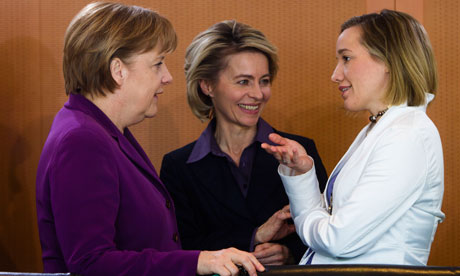
 Three of Germany's most powerful women: chancellor Angela Merkel, left, minister for labour Ursula von der Leyen, centre, and families minister Kristina Schröder. Von der Leyen is in favour of mandatory quotas for female representation in boardrooms, but Schröder would prefer to see voluntary action. Photograph: Markus Schreiber/AP
Germany's top industrial companies have promised to recruit and promote more women, especially into executive management positions.
The 30 companies listed on Frankfurt's Dax index of leading shares said after meeting ministers on Wednesday that they would set targets to promote more female managers. The German government indicated that the firms would aim to increase female representation on their boards by 30% by 2013. It said that companies that failed to meet these goals would face as yet unspecified sanctions.
Ursula von der Leyen, Germany's minister for labour, who has led calls for many more women in the boardroom, wants to see an average of 30% female representation on supervisory and executive boards among listed companies by 2018. The figure for Germany's 200 biggest companies is currently 3.2%.
"I'm not seeing concrete statements, figures, strategies, timetables. We are at the start of a process – it has to have a target and an end," she said. "Small businesses have already shown that this works, and they've stuck to it, but larger companies haven't – nothing has changed. I don't see why women are shut out of banks, or insurance, or companies listed on the stock exchange. That's not the case internationally. [Germany is] behind China, Russia; we're on the same level as India."
Von der Leyen's desire to introduce quotas is strongly opposed by employers and is a more hardline position than that taken by many of her fellow ministers.
Angela Merkel, Germany's chancellor, has described the situation as a scandal and said earlier this month that "things will have to change". However, Kristina Schröder, the family affairs minister, is opposed to quotas. She has said that if firms did not triple the number of female top executives by 2013, the government could set targets. "Quotas are always a supporting crutch, but sometimes they are necessary, and that's why I'm suggesting a flexible quota, which the companies agree among themselves, because that's the way they take much more responsibility for the issue," Schröder said.
Employers are also against quotas, but accept that they have to make changes. Harald Krüger, BMW's personnel director, said that the 30 Dax-listed companies were "fighting for the best solution".
The president of the Federation of German Industry (BDI), Hans-Peter Keitel, has joined the campaign and urged companies to step up their efforts to increase the number of women in executive roles, the broadcaster Deutsche Welle reported. In a letter to his members, however, he rejected von der Leyen's approach.
"In the not-too-distant future it will be worth it to have a good reputation in the field of gender equality," Keitel wrote. But he added: "You can't lay down or define this from above, because the conditions and profiles for managerial positions in individual companies are too varied."
Last month an inquiry into female representation in British boardrooms by Lord Davies ruled out setting quotas, but said that FTSE 100 companies should aim for 25% by 2015. Currently only one in eight directors are women. Norway introduced a 40% quota in 2003 and saw representation jump from 6.8% to 44.2% by 2008.

Nini/guardian

China, Germany lead clean energy recovery

Germany is second only to China when it comes to investing in renewable energy. Global spending on small-scale wind and solar energy, two German fortes, has been especially high, according to a new environmental study.

Investment in renewable energy hit a new high in 2010


Investment in renewable energies has recovered from the global economic downturn, with China and Germany leading a boom in the industry.  

Germany doubled its investment in renewable energies in 2010 to $41.2 billion (29 billion euros) to move past the United States and into second place worldwide, according to a study released on Tuesday by the Pew Charitable Trusts.

China was named the world's leading renewable energy investor with a $54.4 billion investment, up from $39.1 billion in 2009, according to the US non-profit group's study.

The US increased its investments by 50 percent to $34 billion. Italy was the fourth largest investor in clean energy with $13.9 billion.

Using figures compiled by Bloomberg New Energy Finance, the PEW report estimated that total global investments in the clean energy sector in 2010 reached $243 billion, an increase of 30 percent from 2009 when the sector stagnated because of the global recession.

G-20 spends most

"Looking at global trends, the solar sector experienced the strongest growth among the various technologies," Michael Liebreich, CEO of Bloomberg New Energy Finance, said in a statement.

"Declining prices and important government support helped the solar sector achieve 40 percent of total clean energy investment in 2010."

Overall investments in clean energy, which exclude nuclear power and research and development funding, in the Group of 20 major economies rose 33 percent last year to $198 billion amid recovery from recession, the report said.

The G-20 accounted for 90 percent of global investment in clean energy.

The study showed that 40 gigawatts of wind and 17 gigawatts of solar energy were installed during 2010, taking the global clean power capacity to 388 gigawatts.

Big production, small projects

Europe was the leading recipient of clean energy finance with a total of $94.4 billion, led by more than 100 percent growth in small-scale solar installations in Germany and Italy, the report said.

"It's logical that renewable energy in Germany comes from small-scale production since there isn't very much space for big facilities," Stefan Gsänger, secretary general of World Wind Energy Association, told Deutsche Welle.

Wind power continued to be Germany's favored technology attracting $95 billion, the PEW study said.

The solar sector, however, also experienced significant growth in 2010, with global investments increasing by 53 percent to a record $79 billion and more than 17 gigawatts of new generating capacity.

Germany accounted for 45 percent of global solar investments in 2010 and was the world leader in photovoltaic solar technology with some 17,500 megawatts of solar capacity.

Premiums pay dividends

Among the first countries to introduce feed-in tariffs, Germany has benefitted from the premiums paid to those producing energy from renewable sources by luring companies to the country, the PEW report said.

Despite leading the world in terms of greenhouse gas emission, the study named China "the world's clean energy superpower."

China accounted for more than half of the market for new wind turbines in 2010 and is an important player in the renewable energy market, according to Gsänger.

"China is doing a lot to support renewable energy," he said. "Within four to five years China moved from being a minor market to the top market. China is showing the rest of the world it wants renewable energy, and in terms of wind energy you cannot say that China is in any way neglecting investment."


Nini/dw-world


Germany's top 30 firms to promote women

BERLIN (AP) — Germany's leading industrial companies pledged Wednesday to recruit and promote more women, especially in top management jobs, but remained at odds with the government over how best to do it.
The 30 companies listed on Frankfurt's DAX index of blue chip stocks pledged after a meeting with ministers to set company-specific goals to promote more female managers.
"Our goal is to reach a sustainable, company-specific personnel development, as well as adequate representation of women in leadership positions, particularly in top-level management," the companies said in a joint statement.
When the German Economic Institute compared the representation of women in boardrooms in Germany with 10 other developed and developing nations, Germany tied for last place with India, with only 2.2 percent.
Politically, the country ranks better, with women more fairly represented in most political parties and holding six of 16 ministerial posts in Chancellor Angela Merkel's Cabinet.
Merkel's minister for families, Kristina Schroeder, released the outline of a government program aimed at pressuring the private sector to better promote qualified women, especially to increase female representation on their management boards by 30 percent by 2013.
The program requires companies to develop internal plans for how to increase the number of women in their boardrooms. Those plans are to be made public and updated annually until 2013.
In 2001, German companies agreed to voluntarily promote more women, with very little to show for it a decade later. In hope of ensuring the new measures will have an impact, they are to eventually include legislation that would bring sanctions against firms that fail to increase their numbers of female managers.
"We are at the beginning of a process," Labor Minister Ursula von der Leyen, whose push for a quota for women met with resistance in Merkel's government, told reporters.
Details of both agreements proposed on Wednesday remain under discussion and BMW personnel director Harald Krueger said the companies "are fighting for the best solution."
The companies are arguing that it is important to recruit younger women into lower level jobs and groom them to move up within the firm, while the government insists that more women in upper management positions will have a trickle-down effect.
Given the technology-heavy emphasis of many of the DAX companies, including BMW, BASF, Daimler Siemens and Volkswagen, they say they face a legitimate challenge of finding enough women qualified to work for them at any level.
"The most helpful thing for us would be to see more women in technical professions," said Siemens personnel director Brigitte Ederer.

Nini/Google

Germany scalp provides a huge boost

SO THIS was just a friendly. Against a sub-strength German side. No one cares about these games. It doesn't mean a thing. Really?
Don't believe the anti-hype. This result matters for a whole host of reasons. To down Germany at home is a hugely significant result for Australian soccer, and one that will be noted way beyond Monchengladbach.
Defeating Germany in their own backyard puts yesterday's game straight into the Socceroos' own hall of fame. There were games where the result mattered more for literal reasons - reaching the 2006 World Cup, starting that tournament with a spectacular win or qualifying for the 1974 World Cup were all pivotal moments.
But just as the 3-1 win over England in 2003 served notice that Australia had a team laden with potential, the defeat of Germany re-establishes Brand Socceroo in the eyes of soccer observers delighted by the exploits in 2006 under Guus Hiddink - home and abroad. Australia became the neutral's favourite then, as the team that dared.

Four years later it was more the team that died, getting away lightly with a 4-0 thrashing first up from these very same opponents.
What stuck in the craw was the limp exercise in damage limitation that our opening game of last year's World Cup became from the off.
But no one doubts the architect of yesterday's win. Holger Osieck showed he can make slight but telling adjustments at halftime, to tactics and his team's psyche.
So why was it so important? First, it lays the ghosts of losing 4-0 in Durban to rest. It's only a modicum of compensation for that day of horror, but pride is restored. Second, it shows the Socceroos remain capable of punching above their weight.
This, after all, was a German team with a combined
caps total around 350.
In the first half there was much of the pace, movement and technique we so admire in Die Mannschaft, yet Australia responded with a tireless and fruitful second half of their own.
The result will also reinforce the belief the Australian players have in their manager, a figure who bemused them at first but is growing into the role rapidly.
The success of Osieck's selections - the promotion of Jedinak and McKay, the pairing of Kewell and Cahill (though the latter was absent injured in Germany) - adds further to the gravitas.
Coming on the back of a glorious grand final, it is a wonderful shot in the arm for the game here.
After the Asian Cup and this, you sense tickets for June's two friendlies will now be in hotter demand - as might be the team itself when officials seek opponents down the line.
Depending on the draw for the World Cup qualifiers (to be made in July) there is the chance of a friendly on October 7 - the credibility of the Australians in the eyes of prospective opponents suddenly rises.
Yes it was only a friendly yesterday, yes it was only one game, yes there was an element of opportunism. But the display, in the second half at least, encapsulates progress since last August.
Sometimes you only appreciate how far you've come by stepping back and taking in the view.


nini/dailytelegraph

Megan Hart: Reading through the Quran, a few first observations

I wasn't quite sure how to take it when I got “The Complete Idiot's Guide to Understanding Islam” in the mail.
The book, sent by the Council on American-Islamic Relations, was one of several surprising results of my column a few weeks ago about my plan to read through the Quran. I also received a copy of the Quran with commentary (which is much longer and heavier than the commentary-free version I had been using), and a Facebook "friend request" from a medical student in Pakistan.
From the opposite viewpoint, someone sent a copy of a speech about the threat Islam presents to America, and two people suggested a DVD made by a former terrorist who converted to Christianity.
While receiving the “Complete Idiot's Guide” wasn't the most flattering moment of my career thus far, it has provided an interesting starting place for the study of Islam, as has the commentary-enhanced copy of the Quran. I have to read both, along with my uncommented copy of the Quran, with the understanding that they are written by Muslims, with obviously positive views of Islam, with the same skepticism I have for Christians writing about other religions.
So here are a few interesting notes on what I've found so far:
• There is no concept of original sin in Islam. Christians believe that Adam and Eve's original sin of disobedience to God was passed to their descendants, and all are born sinful and cannot save themselves by their actions. Therefore, they depend on faith in Jesus' power to take away their sins. By contrast, Muslims believe children are born innocent, and need only live good lives in obedience to Allah's commandments in the Quran.
• A translation of the Quran is not considered the “true” rendering of Allah's word, which Muslims believe was conveyed in Arabic because of its linguistic peculiarities. Muslims learn certain prayers in Arabic, but those who live in non-Arabic speaking countries are not required to study the language. They can do so, read translations, or trust the interpretation of those who can read Arabic.
• Muslims believe that the Quran was revealed by Allah to Muhammad in one big piece, almost as if it were downloaded to his brain. Therefore, they believe the Quran is entirely the word of God, and Muhammad's role was basically to transmit it orally to his followers, who later wrote it down. Most Christians, however, acknowledge that the Bible was written by multiple people over time, which sometimes creates disputes about what was the true word of God, and what was commentary by the authors.
I'm still slowly making my way through the Quran, as I did with the Bible when I was in college. Keep checking MLive for updates, or even better, join me in reading. You might find a few surprises.

NIni/mlive

Pakistan handles Islamic extremism with kid gloves

Men remove damaged motorbikes from the site of a suicide bomb attack in Swabi March 30, 2011. A suspected suicide bomber blew himself up near a gathering of Islamist party Jamiat Ulema-e-Islam (JUI) in the northwestern town of Swabi, killing 12 people including a policeman, police said.

Photograph by: K. Parvez, Reuters


ISLAMABAD — Loud and combative, Fauzia Wahab is unafraid to denounce mullahs or defend deeply unpopular America. In recent weeks, however, the liberal lawmaker has sat hunkered down in her home in Karachi, rarely stepping out her front door.
Islamic militants elsewhere in Pakistan have assassinated a Cabinet minister and a prominent governor since the first of the year. But the Taliban and other violent extremist organizations aren't the only cause for concern.
The killings of Minority Affairs Minister Shahbaz Bhatti this month and Punjab Gov. Salman Taseer on Jan. 4 have also exposed just how deep extremism has seeped into Pakistani society. When Taseer's assassin, a 26-year-old police commando, made his first court appearance, lawyers in their traditional black suits and black ties greeted him with kisses and a cascade of rose petals.
A weak and corrupt government, led by the secular Pakistan Peoples Party, or PPP, has proved powerless. Even as it has launched military offensives against the Taliban in several areas, it has sought to appease militants in everyday Pakistani society. And it has barely tried to stem the tide of radicalization in universities, the media, security forces, political parties and even the legal community.
The military and intelligence communities also have the power to intervene. But both have ties to Islamic militants that go back decades.
"I have been advised by everyone to go home, to go into hibernation," Wahab, a ruling party member, said in a telephone interview from her home. "What else can I do? Am I supposed to come out on the road and say, 'Come on and kill me?' They are roaming around, and our lives are under threat."
The country's leaders have conspicuously steered clear of the issue that cost Taseer and Bhatti their lives: a blasphemy law that makes it a crime to insult the Prophet Muhammad, the Quran or Islam. Human rights advocates say the law is frequently used to settle scores or persecute minorities, particularly Christians. Those found guilty may face the death penalty.
Both Taseer and Bhatti, a Christian, spoke out against the law. But after Taseer's assassination, leaders of the ruling party dropped any talk of reforming the law; instead they vowed to not tamper with it.
Extremists were unconvinced and responded with a steady stream of death threats. Sherry Rehman, a leading PPP lawmaker who had proposed amendments to the law, received a spate of them. She has pulled back the amendments and, like Wahab, sits holed up in her Karachi home.
Although Wahab hasn't spoken out about the blasphemy issue, she received threats after saying CIA contractor Raymond Davis, who was accused of murdering two Pakistani men in January, had diplomatic immunity and should be released. (Davis was freed this month after the families of the two men were paid $2.34 million.) Wahab has also accused Pakistan's judiciary of being soft on militants.
Ayaz Amir, a journalist and lawmaker from the main opposition PML-N party, said the killings of the two politicians "have reduced the space for rational talk _ people are afraid right now."
"In private, politicians will talk about these things, but on the floor of parliament, on talk shows and in the press, they prefer to keep quiet," Amir said. "This encourages an atmosphere of intolerance to spread."
No institution appears immune. At the prestigious University of the Punjab, a radical group has clamped down on anything it deems un-Islamic, be it music classes or male and female students being seen together. When a professor had several of the group's students expelled for violent behavior last year, other members severely beat him with rods and sticks.
Even the upper chamber of parliament, the Senate, has been affected. After Taseer was assassinated, a move to offer a traditional memorial prayer was rejected, which observers said reflected the raw emotions caused by differences over the blasphemy law.
Meanwhile, extremist groups have been emboldened.
At a rally last month by Jamaat-ud-Dawa, a group regarded in the West as a front for the banned militant organization Lashkar-e-Taiba, more than 20,000 Pakistanis jammed a highway in the eastern city of Lahore to hear Islamist leaders urge the government to establish a ministry for jihad, or holy war. India and the West have accused Lashkar-e-Taiba of masterminding the terrorist attacks in Mumbai in 2008 that killed more than 160 people.
"I can assure you that the funding for this ministry will be given by (Jamaat-ud-Dawa), and we will present a million trained sons of ours for this purpose," the group's political affairs chief, Hafiz Abdul Rehman Makki, told the crowd. "Give these million warriors of God AK-47s!"
Analysts say radical groups can attract large numbers because the government, hopelessly mired in corruption and inefficiency, doesn't provide the unemployed, discouraged masses with much of an alternative.
A third of the population lives below the poverty line. Nearly 7 million children between the ages of 5 and 9 do not attend school, and two of every three youths of secondary school age stay at home. Almost half of the population is illiterate.
"There's only one way to turn this around," said Najam Sethi, the former editor of the Daily Times, a liberal-leaning newspaper published by Taseer. "Show that liberal democracy delivers _ delivers governance, delivers transparency, delivers the nation into the global economy, delivers jobs, delivers livelihoods and fills up empty stomachs."
"You've got to give people all that to make them turn away from the emptiness of ideology and outrage and passion," Sethi added. "But what has happened is that democracy has not delivered."
Sethi blamed former military ruler Gen. Zia ul-Haq for encouraging the growth of political Islam in the 1970s and 1980s. It was Zia who first imposed a blasphemy law to help win the backing of hard-line religious parties.
The influence of extremists could also be reined in if the military and intelligence communities intervened. But bonds between the Islamists and the generals are resilient and time-tested, dating back to the period when the CIA and Pakistan's Inter-Services Intelligence directorate teamed up to help mujahedeen in Afghanistan.
Although recent military offensives in places such as the Swat Valley and South Waziristan have attained some success against the Pakistani Taliban, elements of the intelligence community continue to nurture ties with militant leaders they consider useful.
Pakistan's intelligence community regards some militants as "strategic assets," said a senior intelligence official who requested anonymity because he is not authorized to speak on such matters.
"Putting these people in prison is a sort of control mechanism," the official said. "Though they are able to still able to run their organizations effectively from prison, it's a bit of a cooling-down period for them, a time to hibernate."
Wahab says there was a moment when leading politicians could have rallied behind Rehman's legislation, which would have removed the death penalty and required prosecutors to prove that the alleged blasphemy was intentional.
"But within no time everyone disowned her or kept quiet," Wahab said. For now, Wahab is in no position to lead the countercharge.
"Most likely I'll be working from my home," she said, sighing. "I'll have to be very careful about my movement."


NIni/montrealgazette

Geert Wilders, Anti-Islamic Dutch Politican, 'Hate Speech' Trial To Move Forward In Amsterdam

Despite repeated requests to dismiss the case, the trial of Dutch politician Geert Wilders, who is charged with inciting hatred and discrimination against Muslims, will go ahead.
As the BBC is reporting, Wilders -- whose Freedom Party is propping up an all-conservative minority Cabinet -- had argued the Amsterdam-based court could not try the case as the alleged offenses took place in The Hague.
Having once compared the Koran to Adolf Hitler's Mein Kampf, Wilders also insists his controversial remarks on Islam were part of a legitimate debate and therefore within his free-speech rights. "I've had enough of Islam in the Netherlands; let not one more Muslim immigrate," Wilders is quoted by the Associated Press as saying. "I've had enough of Islam in the Netherlands -- ban that fascist book."
For their part, prosecutors argued the WIlders "made expressions insulting to Muslims as a group," and "incited hatred against people, namely Muslims, on the basis of their religion or race."
According to the AP, Wilders' detractors say the politician's remarks have led to increased discrimination against Muslims in the Netherlands, where they make up around six per cent of the population, and impinges on their right to freedom of religion. In 2008, Wilders shot to international notoriety with the release of a short film Fitna, which mixes Koranic verses with footage of extremist attacks, Al-Jazeera reports.
The trial is adjourned until April 13, when three experts on Islam and the Middle East will be called to give evidence with a verdict expected in June.

Ex-aide: Religion biggest hurdle to Romney nomination

'It’s not something you can poll ... There’s just a bias out there' 


Former Massachusetts Gov. Mitt Romney and his wife, Ann, arrive at the Carroll County Republican Committee Lincoln Day Dinner, Saturday, March 5, 2011, in Bartlett, N.H.
Mitt Romney’s religion — not his frequently parsed Massachusetts record on health care reform — is the biggest threat to his front-running status in the GOP presidential primary, a former top adviser said on Tuesday.
Carl Forti, Romney’s deputy campaign manager and political director in 2008, told the National Journal Insiders Conference that the yet-undeclared candidate in 2012 will face prejudice because of his Mormonism.
“It’s not something you can test. It’s not something you can poll,’’ Forti said after a bipartisan panel at the Grand Hyatt in Washington handicapped the 2012 field. “There’s just a bias out there.’’
Democratic pollster Mark Mellman agreed, calling it “the last acceptable social prejudice.’’
Romney’s political committee did not immediately respond.


Mormonism is viewed as a cult by some evangelicals, who wield considerable influence in GOP primaries. Romney gave a major speech addressing his religion in 2007 and wants to focus his 2012 campaign on the struggling economy, playing to his strengths as a successful corporate executive.
But the former Massachusetts governor’s health care record could be a major stumbling block. It included an “individual mandate’’ for people to buy insurance so that the healthy and the sick alike share costs. That’s also the linchpin of the legislation passed by Congress last year that GOP leaders are trying to repeal.


Romney agrees with the repeal effort and draws a distinction between “Obamacare’’ and his state-level initiative.
In a new poll of National Journal Political Insiders, Republicans rated Romney their party's most likely nominee, followed by Tim Pawlenty, the former Minnesota governor, who recently launched an exploratory committee. Sarah Palin, the former vice presidential nominee who has not revealed her plans for 2012, has dropped to ninth place.
Story: GOP insiders say Romney's still number one Rep. Michele Bachmann of Minnesota scored even lower in the survey, despite receiving enthusiastic receptions by Iowa voters in recent weeks. Both Palin and Bachmann are known for making provocative, headline-grabbing remarks, and whether they will run for president is one of the biggest questions looming over the race.

“I don’t think there’s space in the electorate for both of them,’’ said Sara Fagen, a top Pawlenty adviser who was White House political director under George W. Bush.
“If Palin or Bachmann is the nominee, Obama will win in a landslide,’’ longtime Democratic strategist Tad Devine predicted. “I don’t think either one of them under the scrutiny of a long campaign will survive that scrutiny and pass the threshold of credibility for president.’’
Obama’s biggest challenge, Devine said, is bringing back the “Obama electorate.’’ That’s a younger and much more diverse group of voters than the electorate that widely repudiated Democrats in 2010. The fast-growing Hispanic population, which favors Democrats, is key.
Fagen and Forti acknowledged that the GOP turned off many Hispanic voters with harsh rhetoric about immigration. Fagen’s former boss, President Bush, touted legislation that would have allowed illegal immigrants to earn citizenship, unleashing a fierce debate that is partly blamed for Republican losses in 2006 and 2008.

Forti, who now works as a consultant to American Crossroads, a fundraising powerhouse for conservative Republicans, said that the GOP could also run into problems if it continues to push for Social Security reform. Several potential GOP contenders have been calling for Congress to reduce the costs of entitlements, such as Social Security and Medicare, to help close the federal deficit. As a lifeline for many older and dedicated voters, Social Security was long considered politically untouchable.
“No one believes that the government will let Social Security go bankrupt,’’ Forti said. “It’s hard to articulate a solution until you have sold the problem.’’
Hagen disagreed. She argued that the time is right for politicians to take on an issue that long has been regarded as the third rail of American politics. Bush couldn’t even get a hearing on Social Security in a GOP-controlled congressional committee, Hagen noted. But now, she said, “I think the country expects it.’’
The article, "Ex-Adviser: Romney Faces Religious Bias," first appeared in the National Journal.


nini/msnbc

Polygamy is bad, but religious polygamy worse: lawyer

VANCOUVER — A B.C. government lawyer says polygamy isn't illegal because it's a religious practice -- but he says religion certainly makes it worse.
The B.C. Supreme Court is examining whether Canada's law against polygamy is constitutional, and the provincial and federal governments are arguing in closing submissions that the practice is inherently harmful and the law should be upheld.
Critics of the law, including residents of the polygamous commune of Bountiful, B.C., claim the ban on multiple marriage infringes on their religious freedom and targets polygamists because of their faith.
B.C government lawyer Craig Jones insists polygamy is illegal because it is harmful to women and children, regardless of whether it's a religious practice.
Still, Jones says polygamy that is motivated by religion, such as in Bountiful, is more harmful because religion is used as an instrument of control.
He also rejects the argument that the secrecy in Bountiful would disappear if polygamy were decriminalized, saying the community would still cover up crimes inherently linked to polygamy, such as child sexual abuse and human trafficking.

Nini/ctv.ca

'Quran on trial' more despicable than book burning

Douglas Sharp Dean of the Academy, Protestants for the Common Good
Given the global attention received last fall by the Florida pastor who announced that he would burn the Quran on the anniversary of 9/11, I was frankly surprised to learn that he had found a way to break his promise and burn one anyway.
Pastor Terry Jones and his congregation at Dove World Outreach Center had managed to stay below the national media radar; most people probably forgot about them in places other than their community of Gainesville, Florida. But they have certainly been caught in the radar now, having done something even more daring and despicable than the demeaning act of burning a copy of the Quran.
The pastor held court with the Quran as the defendant. On March 20, 2011, he set himself up as the judge, invited a Muslim who had converted to Christianity to serve as prosecuting attorney and the president of the Islamic Center of Texas to act as defense attorney. “Expert” witnesses included other Muslims who had converted to Christianity.
What were the charges? In his video on the Stand Up America website, Pastor Jones said, “We are accusing the Quran of murder, rape, deception, being responsible for terrorist activities all around the world. We are accusing the Koran of these violent acts.”
Anticipating a “guilty” verdict, the question announced in advance on the lawn of the church’s property was whether the Quran should be burned, drowned, shredded, or shot. Following the jury’s rendering of the verdict, the Quran was soaked in kerosene and ignited, like charcoal in a barbeque pit.
In spite of all the absurdity and chicanery of this “mock trial” and the sophomoric behavior of its master-mind, I find this whole affair to be not at all amusing. To the contrary, it is not only a shameful display of religious bigotry and ignorance, but also a burlesque-like mockery of our system of jurisprudence. All things considered, it is frighteningly childish act.
What I find so alarming about this act is the extent to which Jones and his flock have gone to accomplish now what they set out to do last fall. All the reasons given then for not burning a copy of the Quran still apply: inflaming the Muslim world, aiding and abetting Al-Qaeda’s recruitment, putting U.S. military personnel forces at greater risk, etc.
But surrounding oneself with the accoutrements of justice and feigning to sit in judgment on the sacred literature of 23 percent of the world’s population, about whom you really—and evidently—know next to nothing, is a most disturbing demonstration of antipathy in search of a venue in order to attract attention and stoke further the barbeque pit of mind-numbing evil.

nini/chicagotribune

Ind.'s Earlham College names new president

Earlham College has named John David Dawson, a professor of religion at Pennsylvania's Haverford College, as the new president of the Quaker-affiliated liberal arts college.

The Richmond school's board of trustees announced Dawson's hiring Wednesday. He begins his tenure July 1 and will succeed Douglas C. Bennett, who's retiring after 14 years as president.

Earlham board chairwoman Deborah Hull says Dawson "brings with him a wealth of scholarship and a deep commitment to social justice issues."

In addition to overseeing operations at the 1,100-student eastern Indiana college and its School of Religion, Dawson has also been named a full professor of religion at Earlham.

Nini/chicagotribune