
Passengers to feel brunt as Qantas talks collapse

Thursday, February 10, 2011

QANTAS passengers should brace for widespread flight delays and the possibility of cancellations as pilots square up for a fight with the airline that has been years in the making.
Negotiations between Qantas and its international pilots over a new employment agreement broke down on Wednesday night when the company's chief executive, Alan Joyce, flatly rejected pilot demands for a guarantee of long-term job security and a pay rise.
The pilots are trying to secure their position at the airline as it continues to expand through subsidiary companies such as Jetconnect and Jetstar.
They claim Jetconnect is a ''sham company'' set up by Qantas for the sole purpose of avoiding its obligations under the award, and undermining the employment agreement it has with Qantas pilots.
The union says Qantas makes a double saving by using Jetconnect. Not only does it pay its pilots lower wages, it can also reduce the amount of work it has to give to other pilots employed under the more-generous Qantas agreement.
This ongoing stoush is threatening to become open warfare. About 100 off-duty pilots will meet at the St George Rowing Club this morning to publicly express their anger and discuss what industrial action to take.
The Australian and International Pilots Association said it expected a formal protected action ballot to be held within the next two weeks, meaning that action could begin as early as next month.
A full-blown strike is unlikely, but pilots are considering a range of different options for industrial action, including stop-work meetings and a go-slow.
Should Qantas's 1700 international pilots pursue either of these options, there would be delays across the airline and possible cancellations.
''Everything is on the table,'' said an association source regarding the different options for action. ''We could, for instance, decide to take things very, very carefully, if you take my meaning.''
Qantas yesterday accused the union of posturing as part of its claim for increased wages and better conditions.
It denies pilots' jobs or conditions are under threat and has accused the pilots of misleading the public about the real size of their wage claim.
''The combined effect of the wage claim, classification table and travel claims submitted … is a cost increase of approximately 26 per cent over three years,'' a Qantas spokesman said. The pilots said their claim was just 2.5 per cent a year.
''Qantas rejects demands from the union that only Qantas pilots should fly planes in other Qantas Group airlines [Jetstar, Jetconnect],'' the spokesman said.
He said the airline had not put contingencies in place for industrial action as it was still focusing on negotiations between the two parties which are scheduled to recommence next week. But the atmosphere in the talks is unlikely to be friendly.
In a blistering attack yesterday, the pilots' association said Qantas was ''on the brink'' as the airline's management ''trashes its brand'' and seeks to ''smash its pilots''.
''We are witnessing the demise of an icon through mismanagement,'' its president, Barry Jackson, said in a statement.
''This dispute is about jobs and whether there will be a recognisable aviation industry based in Australia in the future.''

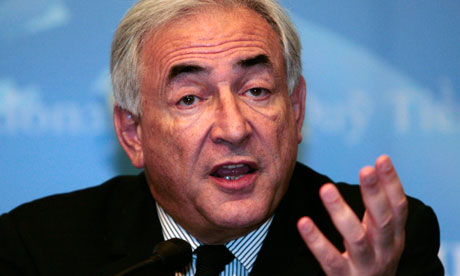
IMF boss calls for global currency

IMF managing director Dominique Strauss-Kahn thinks the fund's Special Drawing Rights could be used as a global currency. Photograph: Larry Downing/REUTERS


Dominique Strauss-Kahn, managing director of the International Monetary Fund, has called for a new world currency that would challenge the dominance of the dollar and help curb future financial instability.
In a speech in Washington, Strauss-Kahn argued that the reserves that member countries held with the fund could be used, instead of the dollar, to price international trade. These so-called special drawing rights (SDRs) could also act as an alternative to the dollar in central banks' foreign currency reserves.
"Using the SDR to price global trade and denominate financial assets would provide a buffer from exchange rate volatility," he said, while "issuing SDR-denominated bonds could create a potentially new class of reserve assets".
The IMF published a policy paper backing Strauss-Kahn's views as it gathered top-level economists for discussions on the future of the international monetary system.
Strauss-Kahn, who has been tipped as a contender for the French presidency next year, also argued that the way SDRs were valued, which is currently based on a basket of currencies – the dollar, sterling, the euro and the yen – be broadened to include others such as the Chinese yuan.
International policymakers have become increasingly concerned about the threat of currency wars as struggling governments try to hold down their own exchange rates as they clamber out of recession.
Strauss-Kahn admitted that there were formidable hurdles to achieving a greater role for SDRs, but he warned that without urgent action, the simmering conflicts in the international financial system could tip the world back into chaos.
"Global imbalances are back, with issues that worried us before the crisis—large and volatile capital flows, exchange-rate pressures, rapidly growing excess reserves – on the front-burner once again. Left unresolved, these problems could even sow the seeds of the next crisis," he said.
China, which holds much of its $2.85 trillion mountain of reserves in US Treasury bonds, has repeatedly expressed unease about the value of the dollar, while American politicians have complained that Beijing gains an unfair advantage by keeping its own currency cheap.
The idea of SDRs emerged in 1969, to support the Bretton Woods fixed exchange rate system, but when that collapsed a few years later, the role of SDRs was largely forgotten. They allow IMF members the right to swap their own reserves for foreign currencies in times of need.
However, at the London G20 meeting in 2009, in the midst of the credit crunch, world leaders agreed a dramatic $250bn boost to SDRs, sparking speculation that they could play a growing role in the global monetary system.
Strauss-Kahn said the IMF was also examining ways of strengthening international policy co-ordination, and monitoring international imbalances.

UPDATE 1-IMF chief urges overhaul of global monetary system

* IMF chief calls for China yuan in global currency basket
* Strauss-Kahn says adding yuan could improve stability (Updates with quotes, background, paragraphs 8 to end)
By Lesley Wroughton


WASHINGTON, Feb 10 (Reuters) - International Monetary Fund chief Dominique Strauss-Kahn on Thursday called for a greater role for China's yuan currency as part of a broad-based overhaul of the international monetary system.
In a speech at the IMF Strauss-Kahn said adding emerging market countries' currencies, such as the yuan, to a basket of currencies that the IMF administers could add stability to the global system.
He saw a greater role for the IMF's Special Drawing Rights, which is currently composed of the dollar, sterling, euro and yen, over time but said it will take a great deal of international cooperation to make that work.
"Increasing the role of the SDR would clearly require a major leap in international policy coordination," Strauss-Kahn said, according to a prepared text of the speech. "For this reason, I expect the global reserve asset system to evolve only gradually, and along with changes in the global economy."
The IMF chief said without changes to the global system the world could be sowing the seeds of the next economic crisis.
He said global economic imbalances were back and issues such as large and volatile capital flows, exchange rate pressures and rapidly growing excess reserves were threatening economic stability.
"In my opinion, reforms to the international monetary system that help us get to the root of these imbalances could both bolster the recovery and strengthen the system's ability to prevent future crises," Strauss-Kahn said in prepared text of a speech.
He said overhauling the international monetary system could bolster the still fragile global economic recovery and help to prevent future crises.
Strauss-Kahn's speech comes a week before finance ministers from the Group of 20 developed and developing nations meet in Paris to discuss proposals by French President Nicolas Sarkozy for changes to global economic governance.
Debate has increased about the U.S. dollar's status as the main global reserve currency, especially with emerging market economies providing most global growth and their increased importance in global financial institutions.
The SDR is seen by some as a compromise currency, one that recognizes both the importance of the major developed economies but also allows for greater representation for emerging economies in its composition.
Among the yuan's drawbacks is that it is not freely traded and China's capital markets are largely closed.
But Beijing has been expanding a pilot program to encourage the use of the yuan in cross-border trade in what economists say is part of a strategy to raise the currency's profile.

The SDR is not a currency. It is an IMF accounting unit, and is only used as a reserve asset by central banks and is not available to the private sector.
An IMF paper released alongside Strauss-Kahn's speech on an enhanced role for the SDR said the U.S. dollar's safe-haven role had been confirmed during the recent financial crisis and would remain the most important global reserve currency "for the foreseeable future".
But the paper noted a greater role of the SDR would reduce currency volatility and would ensure that countries have easier access to foreign exchange funding during a crisis.
The paper also said the using the SDR to price global trade would provide a buffer from exchange rate volatility, while the issuance of SDR-denominated bonds could create a potentially new class of reserve assets.

Indonesia demands probe into attack on Muslim sect

Indonesia's president ordered an investigation into an attack on members of a minority Muslim sect after a gruesome video emerged of a mob beating several victims to death with machetes, sticks and rocks.
About 1,500 people stormed a house in Banten province over the weekend to stop 20 Ahmadiyah followers from worshipping. They killed three men and badly wounded six others, while destroying the house and setting fire to several cars and motorbikes.
Indonesia is a secular country of 237 million people with more Muslims than any other in the world.
Despite a long history of religious tolerance, a hard-line fringe has grown louder in recent years and the government - which relies on the support of Islamic parties in Parliament - has been accused of caving in to it.
Rights group said Tuesday a 2008 decree that bans religious activities of Ahmadiyah, thought to have 200,000 followers in the archepeligic nation, should be immediately revoked. They say it only encourages violence.
The latest attacks on Ahmadiyah - which drew rare condemnation from President Susilo Bambang Yudhoyono - were captured on video and have circulated widely on national television and the Internet.
The most disturbing clip, posted on YouTube, showed assailants repeatedly pounding two victims - who had been stripped naked and appeared to be dead - with heavy sticks.
A policeman came to the scene but his screams of "stop" were almost inaudible among dozens who shouted "Allahu Akbar" or God is Great.
The Ahmadiyah are considered deviant by many Muslims and are banned in many Islamic countries because they believe that Muhammad was not the final prophet.
"I have ordered a comprehensive investigation to find out the real cause of the incident so that those guilty, or violating the law, can be penalized," Yudhoyono told a news conference.
He also called on security forces as well as local governments to be proactive in taking action against the instigators of such violence.
"Don't wait until the conflicts and clashes have already happened," Yudhoyono said.
Many attacks on religious minorities in recent years have been carried out by members of the hardline Islamic Defenders Front, known also for smashing bars and attacking transvestites and anyone one else considered "blasphemous" with bamboo clubs and stones.
The group pressured local authorities late last year to shutter a Christian church located in a densely populated Muslim area, and assailants stabbed a Christian worshipper and beat a minister on the head with a wooden plank as they headed to prayers.
Thirteen members of the Islamic Defenders Front have gone on trial in the case, and state prosecutors on Monday sought a six-month prison term for Murhali Barda, a local group leader, for instigating the Sept. 13 attack.
The Setara Institute for Peace and Democracy, a human rights group, says attacks on religious freedom by hard-liners are steadily increasing.
It says in 2010 there were 64 incidents, ranging from physical abuse to preventing groups from performing prayers and burning houses of worship, up from 18 in 2009 and 17 in 2008.


nini/kansascity
                                                                            

exclusive photos after the war Ahmadiyah

Override the Ahmadiyya Community Violence

Violence re-occur on the Ahmadiyah congregation conducted a number of masses in Kampung Babakan Peundeuy, Umbulan Village, District Cikeusik, Pandeglang district, Banten Province on Sunday (6 / 2) morning. Three people were reportedly killed in the attack, hundreds of other residents were seriously injured and ringgan still being treated in hospital. A total mass of Solidarity Action for Action on Violence against Ahmadis by dressing all in black to protest at the Roundabout HI, Jakarta, Monday (7 / 2) ask the president ordered law enforcement officials crack down on perpetrators of the attack.


Ahmadiyah Brought Attack on Themselves: Officials

Two top state officials have blamed Sunday's deadly mob attack on an Ahmadiyah community on the sect itself, saying the government has tried to protect the group.

Three people from the community of 25 in Umbulan village in Pandeglang district were killed during the rampage by about 1,500 people.

On Wednesday, Religious Affairs Minister Suryadharma Ali told a House of Representatives hearing that a controversial joint ministerial decree issued in 2008 was not to blame for the attack, which was just the latest incident of violence targeting the minority Islamic sect.

The decree restricts the Ahmadiyah’s activities and bans Ahmadis from spreading their faith.

National Police Chief Gen. Timur Pradopo, speaking at the same hearing, suggested the Ahmadiyah members in Umbulan had only themselves to blame for Sunday’s fatalities.

Hard-line Islamists involved in attacks against Ahmadiyah communities, schools and mosques have consistently cited the decree — and an edict by the Indonesian Council of Ulema (MUI) branding the sect heretical — as justification for their actions.

Speaking before House Commission VIII, which oversees religious affairs, the minister said the decree was meant to protect the Ahmadiyah.

“The decree was not made to discriminate against certain groups, it was aimed at maintaining religious harmony, including protecting the Ahmadiyah,” he said.

He added that his ministry had been actively engaged in attempting to prevent sectarian clashes, including setting up interfaith forums (FKUBs) in all 33 provinces and 421 districts and cities across the country. He acknowledged, however, that not everyone involved in the interfaith forums was familiar with the contents of the decree.

Timur said local police had been notified a day before the rampage of a possible attack on Ismail Suparman, an Ahmadiyah elder in the village, and had taken him into protective custody.

The subsequent attack, Timur went on, occurred after Deden Sujana, another Ahmadiyah member, occupied Ismail’s house in a bid to defy the mob. “That’s why the mob got out of control and the fatalities occurred on the Ahmadiyah side,” the police chief said.

Deden was one of several Ahmadis critically injured.

Some Commission VIII lawmakers agreed that the Ahmadiyah were at fault.

Hasrul Azwar, from the Islam-based United Development Party (PPP), said the sect should be officially outlawed. “Clerics the world over have banned them, so why doesn’t our government do the same?” he asked. “As long as the government fails to get strict, the conflict will never end. Their fake prophet is a disgrace to my religion.”

Suryadharma said that while the government had not decided what to do with the Ahmadiyah, “the suggestion to disband them will be a very valuable input for us.”

Imran Muchtar, from the ruling Democratic Party, backed the call. “The first option is for the Ahmadiyah to repent, recognize their mistake and come back to mainstream Islam,” he said.

“The second is for them to leave Islam and declare a new religion.”

Jazuli Juwaini, from the Islamic-based Prosperous Justice Party (PKS), called on the police to investigate whether the mob had been organized.

Timur said that while it was obvious that “some people mobilized the masses, I’m not saying they’re the provocateurs.”

He added that the only person arrested so far was Ujang bin Sahari. Unconfirmed reports identify him as the Banten head of the hard-line Islamic Defenders Front (FPI).